Thérence CarvalhoProfessor of Legal History and Political Thought at Nantes Université Français

Books

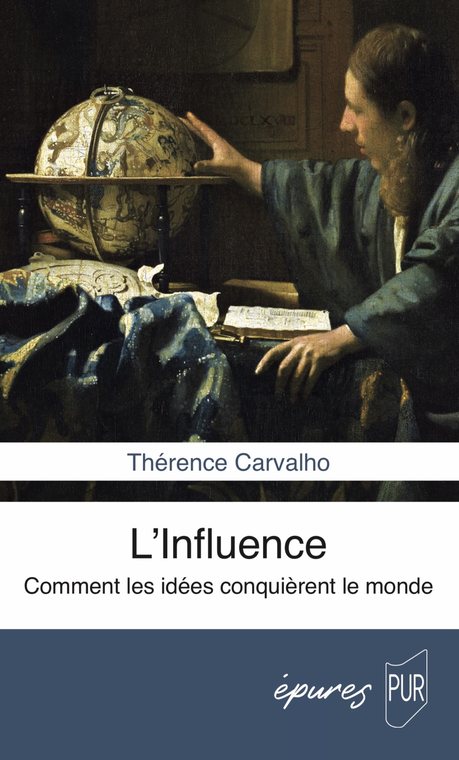
Cover: L’Influence

L’Influence

Comment les idées conquièrent le monde (How Ideas Conquer the World)

Rennes, Presses Universitaires de Rennes, 2026, 150 p.

In an age of social media, fake news and information warfare, influence is everywhere: it shapes our opinions, guides our desires and steers our choices. Yet what do we really know about this invisible force? Why do some ideas leave their mark on history while others sink into oblivion? From ancient eloquence to digital platforms, from the philosophers of the Enlightenment to today’s influencers, this essay shows how ideas spread, seduce, evolve and become genuine powers of action. It examines the strategies of those who influence, the mechanisms at work in those who are influenced, and the mediations that turn a mere thought into a collective force.

Organised around three questions (What is influence? How does one influence? What does it mean to be influenced?), the book lays the foundations of an “influology”: a new way of understanding the fate of ideas and their power to conquer the world.
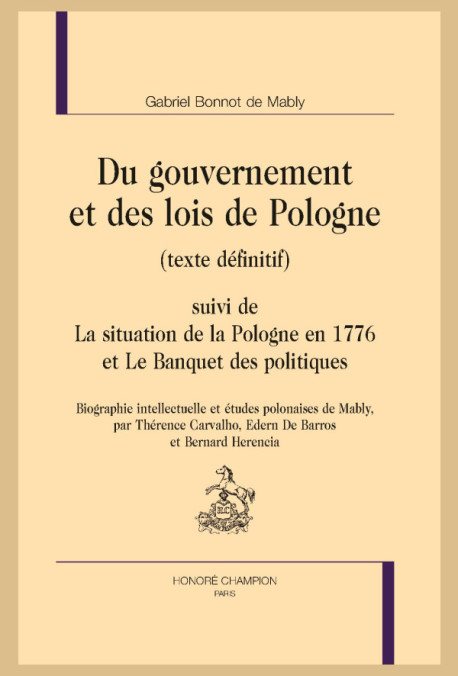
Cover: Du gouvernement et des lois de Pologne

Du gouvernement et des lois de Pologne

by Gabriel Bonnot de Mably, followed by La situation de la Pologne en 1776 and Le Banquet des politiques

Edited by Thérence Carvalho, Edern de Barros and Bernard Herencia

Paris, Honoré Champion, Bibliothèque d’Études de l’Europe Centrale n° 31, 2026, 294 p.

Gabriel Bonnot de Mably (1709-1785), a leading historian and philosopher of the eighteenth century, was one of the forerunners of the French Revolution. As adviser to the Confederation of Bar, he devised reforms designed to balance the powers of the nobility and the monarchy in order to save Poland from imminent dismemberment. This volume brings together Du gouvernement et des lois de la Pologne, De la situation politique de la Pologne en 1776 and Le Banquet des politiques, three texts in which Mably proposes constitutional solutions to preserve Polish independence against Russia, Prussia and Austria. For the first time, this edition brings to light the differences between the 1781 version and the posthumous 1790 edition of Du gouvernement et des lois de la Pologne, offering readers a fresh perspective on the work.

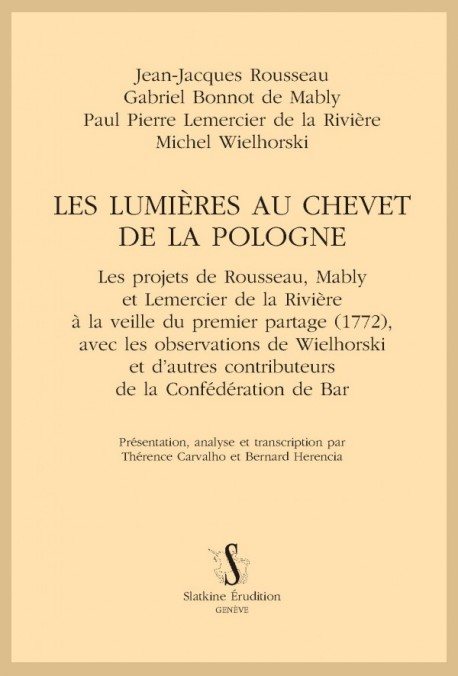
Cover: Les Lumières au chevet de la Pologne

Les Lumières au chevet de la Pologne

Les projets de Rousseau, Mably et Lemercier de la Rivière à la veille du premier partage (1772) (The Enlightenment at Poland’s Bedside)

Edited by Thérence Carvalho and Bernard Herencia

Genève, Slatkine, 2024, 538 p.

In the second half of the eighteenth century, Poland-Lithuania was a republic in peril. Its territory was coveted by Russia, Prussia and Austria, which, after three partitions (1772, 1793 and 1795), would erase the country from the map of Europe for more than a century. Hoping to end the crisis, Michał Wielhorski (1730-1794), envoy of the Confederation of Bar, travelled to France and sought the help of several philosophers. Three thinkers placed their pens at the service of the Republic: Gabriel Bonnot de Mably, Jean-Jacques Rousseau and Paul Pierre Lemercier de la Rivière.

This edition brings together for the first time the unpublished texts of Mably’s four series of Observations sur la réforme des lois de la Pologne, Rousseau’s Considérations sur le gouvernement de Pologne and Lemercier de la Rivière’s L’intérêt commun des Polonais, together with Wielhorski’s own contributions and the hitherto unpublished reactions of the Confederates to Mably’s proposals. This Franco-Polish dialogue, which raises the question of the modernity of republicanism and of its democratic potential, bears exceptional witness to the emergence of constitutional thought in Enlightenment Europe.

Reviews

  • Revue d’histoire de la pensée économique, 2025, n° 19, p. 356-361 (by Marc Belissa) Read online
  • Annales historiques de la Révolution française, 2025, n° 420, p. 229-231 (by Edern de Barros) Read online
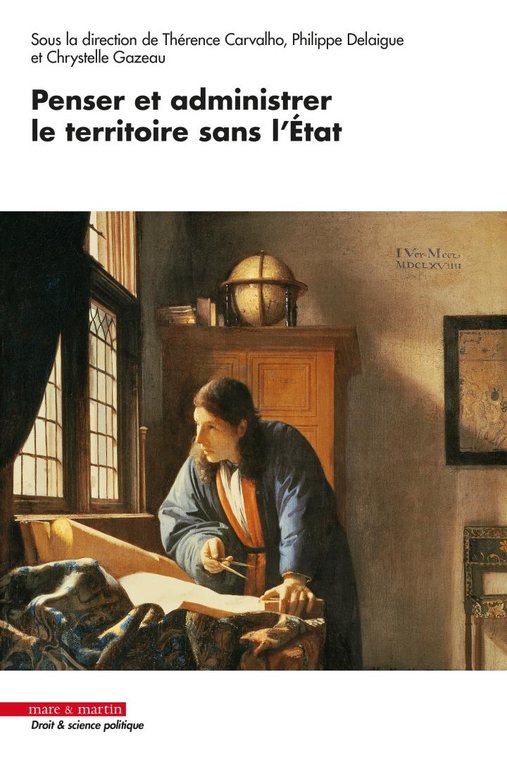
Cover: Penser et administrer le territoire sans l’État

Penser et administrer le territoire sans l’État

(Thinking and Administering Territory without the State)

Edited by Thérence Carvalho, Philippe Delaigue and Chrystelle Gazeau

Paris, Éditions Mare & Martin, 2023, 372 p.

Western law is so deeply shaped by the central fiction of the State that jurists struggle to conceive of its absence. Against a vision distorted by the state-centred lens, this volume explores, from the Roman Empire to the European Union, different ways of thinking about and administering territory without the State. What happens when the State collapses or withdraws? How does a population left to its own devices govern itself? Which legal techniques and political means have been mobilised to overcome such withdrawal or disappearance? This collective and interdisciplinary inquiry addresses these questions across two thousand years of debates and experiments aimed at freeing territory from the State.

With contributions by Pierre Barillé, Pierre Belda, Clovis Bernardi, Héritage Bita Heyeghe, Christian Bruschi, Thérence Carvalho, Anne-Sophie Chambost, Paul Chauvin-Madeira, Philippe Delaigue, Mégane Delporte, Anne Dobigny-Reverso, Jean-Romain Ferrand-Hus, Élise Fraysse, Chrystelle Gazeau, Johann Grémont, Jérôme Henning, Étienne Lamarche, Mathilde Laporte, Efthymia Lekkou, Sarah Rahouadj, Michael J. Strauss, Laura Viaut.

Reviews

  • Revista General de Derecho Público Comparado, 2024, n° 36, p. 529-536 (by Cecilia Pedrazza Gorlero) Read online
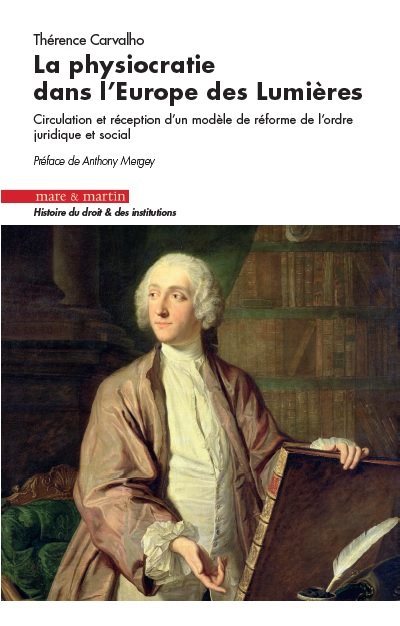
Cover: La physiocratie dans l’Europe des Lumières

La physiocratie dans l’Europe des Lumières

Circulation et réception d’un modèle de réforme de l’ordre juridique et social (Physiocracy in Enlightenment Europe)

Foreword by Anthony Mergey

Paris, Éditions Mare & Martin, 2020, 808 p.

Physiocracy occupies a major place in the history of the Enlightenment. The doctrine developed by François Quesnay, the Marquis de Mirabeau and their disciples constitutes an original model for the reform of Ancien Régime society. Free trade, a single tax on land, the abolition of guilds, the establishment of “legal despotism” and the recognition of the triad “liberty, property, security” as fundamental rights: the physiocrats’ proposals overturned the traditional legal and social order.

Through its universalist theories, physiocracy spread far beyond the borders of France. How did the ideas of this “new science” circulate, and how were they received across Europe?

Prizes

  • Franz Stephan Prize of the Austrian Society for Eighteenth-Century Studies.
  • Montesquieu Prize of the French Association of Historians of Political Ideas (AFHIP).

Reviews

  • Journal of Interdisciplinary History of Ideas, 2021, vol. 10, n° 20, item 7, p. 1-7 (by Manuela Albertone)
  • Contributions to Political Economy, 2022, vol. 41, n° 1, p. 208-210 (by Gabriel Sabbagh)
  • Revue historique, 2022, vol. 703, n° 3, p. 719-722 (by Claude Michaud)
  • Revue historique de droit français et étranger, 2022, n° 2, p. 327-333 (by Anne-Sophie Condette-Marcant)
Cover: Les lois naturelles de l’ordre social

Les lois naturelles de l’ordre social

Réédition scientifique des œuvres de Guillaume-François Le Trosne (A Critical Edition of the Works of Guillaume-François Le Trosne)

Genève, Slatkine, 2019, 511 p.

A magistrate at the présidial court of Orléans, Guillaume-François Le Trosne (1728-1780) was the disciple both of Robert-Joseph Pothier, the most eminent jurist of his day, and of François Quesnay, the leader of the physiocratic movement. This dual heritage makes him a remarkable and singular author of the Enlightenment, who strove throughout his life to unite law and political economy in a comprehensive science of society that would set out the natural laws of the social order.

This edition brings together three of his most important texts, all published in 1777: De l’ordre social, De l’intérêt social and the Vues sur la justice criminelle. Alongside the complete texts, it includes for the first time all the prefaces and notes from the successive editions, together with press notices, extracts from his correspondence, an introduction, a chronology and entirely new annotations.

Reviews

  • Dix-huitième siècle, 2022, n° 54, p. 682-683 (by Claude Michaud) Read online
  • Revue historique de droit français et étranger, 2022, n° 3, p. 445-446 (by Éric Gojosso)
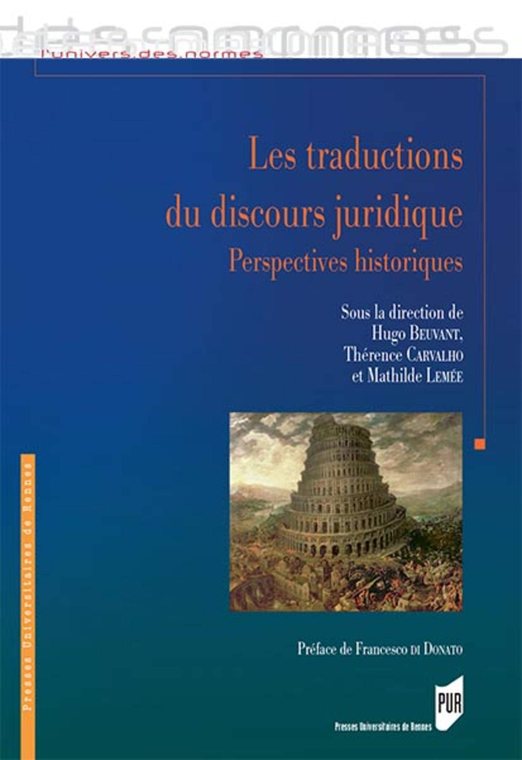
Cover: Les traductions du discours juridique

Les traductions du discours juridique

Perspectives historiques (Translating Legal Discourse: Historical Perspectives)

Edited by Hugo Beuvant, Thérence Carvalho and Mathilde Lemée. Foreword by Francesco Di Donato

Rennes, Presses Universitaires de Rennes, 2018, 204 p.

Is legal discourse condemned to suffer the curse of Babel? In every period of history, jurists have had to confront the linguistic diversity of the world, and they found an effective yet delicate remedy for it: translation. Although the translation of legal discourse has been the subject of several studies, it has too seldom been approached from a historical perspective. Legal history, however, offers countless instances of translatio that illuminate the circulation and reception of legal ideas.

The fruit of an international conference held at the University of Rennes 1, this volume examines the translations of legal discourse through the prism of history, focusing on recurring problems and on the diverse solutions proposed across the ages.

Reviews

  • Revue trimestrielle de droit civil, 2018, n° 4, p. 1010-1011 (by Laetitia Guerlain)
  • International Journal for the Semiotics of Law – Revue internationale de Sémiotique juridique, 2019, vol. 32, n° 1, p. 225-228 (by Ksenia Gałuskina)
  • Rechtsgeschichte – Legal History, 2019, n° 27, p. 310-312 (by Manuela Bragagnolo) Read online